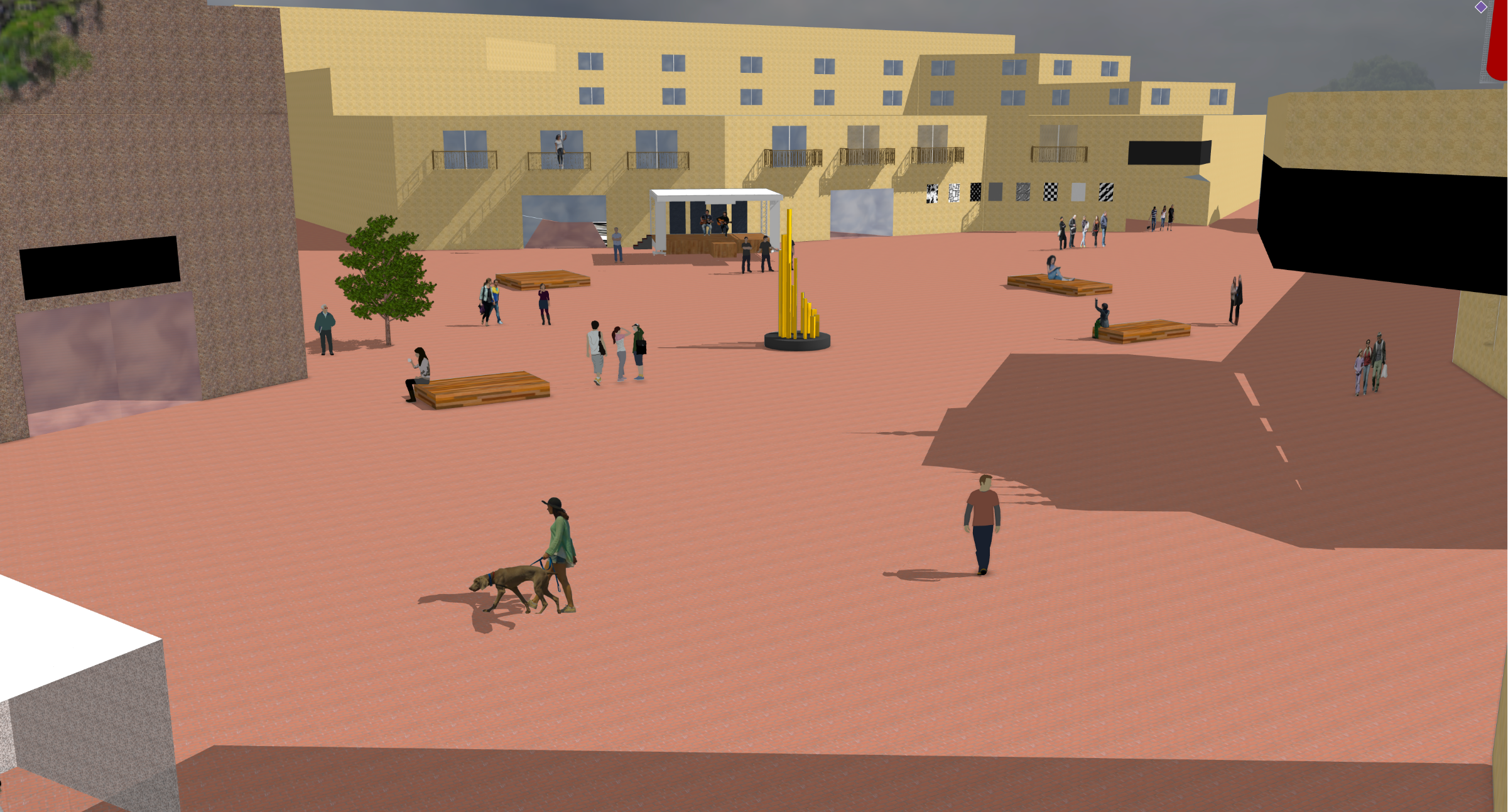

A Theory of Ecosystemic Settlements and How to Build Them
1) Vision
“Early cities did not always leave a harsh footprint on the environment, or on each other.” – David Graeber and David Wengrow, The Dawn of Everything
This document considers a new set of forms, a new way of organizing human settlements. It starts with a fundamental question:
What does a city that assumes the equal standing of all life, within and across species, look like?
On the Need for a Formalized Tool for City Building
To achieve this ideal there is a need for “communal self-governance” (also the Davids). In considering the recommendations presented herein, nothing of the current physical or social form of human-made settlements are taken for granted. It is important to understand that many ways of living are possible, and have been practiced throughout history. Thus, it also does not prescribe one way of organizing land use, beyond the basic, large-scale physical features of interlaced city and country “fingers” (Alexander et al. A Pattern Language). Rather it is meant to be a framework, something to spark imagination and something to look back on to track progress towards the goals of cities over time.
People must agree on its use and thus it should be accessible to all people. As language, landscape, and social needs change, so should the tools employed in making the city. In its current form it addresses several key aspects of current urban life that commonly raise concerns in urbanist and regionalist thought and practice: the definition of cities, scales and rates of development, housing and buildings, landscape, and the social contracts of reciprocity and misconduct.
The contents and context can expand and contract through time. This can be a living document, and should be if we assume we need any sort of external tool to guide the building of cities.
On Human Settlement, Reality, and Utopia
In its present form, this document presents a building up cities and regions from scratch, but principles should be able to be applied to existing places, some all at once, some over time. Utopian vision is necessary to spark hope. And creation of all types is inherently hopeful. It assumes a future, and this is not always a given.
The writing is mean to be “as magical and sober as possible” (Andrew Santa Lucia, personal correspondence). In terms of living in the settlements created with this guidance, this encourages the belief that there is magic in the everyday. Reality doesn’t have to be painful. If we can solve the problems that we have gotten ourselves into we will have more capacity to appreciate what is already around us.
---
The blending of urban and rural in a circumscribed area of land, especially in pre-defined ratios and alternating in semi-regular intervals, is all but unthinkable in the current pattern of development. In a way what is envisioned here is not even a city in our current conception. It is more of a settlement, inhabitation, or circumscribed ecosystem. All of these terms will be used in the document, but so will traditional terms like “city” and “country,” in order to evoke ideas about the differences between them.
When considering a settlement as a complete, circular ecosystem, we must ask what are the flows? Why do the parts (city, country, interface) make sense on their own and in relation to each other? What connection should there be with surrounding settlements, nearby or across the globe?
In the end this document is a set of written recommendations, or Code, for what the author considers an inclusive, beautiful, and long-lasting pattern of human settlement within the larger and less controllable world. Santa Lucia describes Folkcode as “a common or traditional set of ideas or rules about how to behave originating in a city with people typically reflecting their lifestyle” (“Folkcodes and the Urban Legendary”). But lifestyles can also come to reflect the city itself, as they do in the hyper-commercialized-hyper-real world of today. Like the interfaces of city and country described below, the interface of city and society is fuzzy. The aim is to “transcend the opposition between town and country instead of degrading both by turning them into an undifferentiated mass” (Henri Lefebvre, The Production of Space) and to create an “enlightened meshing of nature and culture” (Dramstad, Olson, and Forman, eds., Landscape Ecology Principles).
2) Principles
A) Wants and needs of the city.
I. There shall be no form of social hierarchy in the settlement.
II. Residents of the city will determine as a group how they wish to organize social, economic, and ecological affairs of the city at its founding, and should meet regularly (at least once per month) to update their wishes for the city.
III. In these meetings the residents of the city will decide what objects, ideas, or forms of relationship they Want and Need, with some restrictions outline below.
IV. There should be no official apparatus of punishment. The recipients of antisocial or injurious behavior will decide reparations for misdeeds.
V. All residents of the city should be assumed to be pro-socially minded
VI. There will be no means of converting wealth to power
VII. Wealth will not be determined by amassing of abstractions (money).
VIII. Accumulation of wealth in terms of physical objects or space will be restricted such that no individual, on average, has more than 10% more or less than any other individual
IX. To meet needs and requirements, networks of mutual aid will be organized in the City Finger Centers (described below)
X. Extremes of weather, resources, and population in the present and future should be planned for in decision-making.
XI. The city will be Biophilic and Biomimetic.
XII. Human residents should not try to over-engineer what nature has made. The form of the city will emerge as the land and time allow.
XIII. Beyond this guideline, construction of City Fingers can rely on any desired practice of aesthetics and utility.
XIV. The interface will have some built controls, but will mostly appreciate the emergent properties of natural land and reflect them
B) Productive and Nonproductive Land
I. Productivity will be defined by the full assembly of city residents, but will generally entail the gathering, growing, or making of things
II. No person should be compelled to be Productive against their ability or will
III. Without reliance on abstractions of wealth, goods produced will have value based on their utility and desirability
IV. Since these are subjective terms, values of goods produced are free to change without limit, as determined by residents.
V. Nothing shall be produced that demonstrates or implies hierarchy, the dominance of any individual or group over others, or devalues the lives of others
VI. Voluntary production, especially in any sort of automated or bulk manner, should produce as few goods as necessary and of the highest possible quality.
VII. Technology and automation can be utilized to produce essential goods, as decided by the group
VIII. Individual house and workshops should be established and supported as desired to produce Wanted goods, art, works of philosophy, etc.
IX. Growth of the entire Settlement should be controlled, such that fingers should be developed one pair at a time (city and country), guided by the land’s natural flows
3) Scales
A) District-Wide Framework
These broad principles unite the entirety of the settlement as planned and developed.
I. Size
i. Each Settlement should be autonomous and equal in political status.
ii. Fingers should be built to be approximately 1 mile wide. This allows for both larger cities over time and flexibility of space
iii. Fingers should adapt to the geographies they are built on. Obvious natural boundaries should be respected.
iv. Each city finger will have a central area for gathering, civil engagement, distribution and exchange of goods, etc.
v. Established contacts can build up to a larger region but not form factions for consolidating or egregiously displaying power.
II. Dispersion
i. City Finger centers should be approximately 2 miles apart, the combined width of one city and one county finger.
ii. Neighborhoods and their central hubs should support about 10,000 people
III. Connections
i. Ring roads should circumscribe the entirety of the settlement and connect to major points.
ii. On these roads, bus or light rail should be the preferred modes of transportation in planning and construction.
iii. Design for personal cars is allowable, with no more than one lane in either direction (clockwise or counterclockwise).
iv. These need not be made at the outset of building, rather they should be planned for the long-term growth of the settlement and built incrementally.
v. Paths between neighborhood centers should be straight lines if the geography allows it. These should have the character of traditional city streets, with stops, destinations, and public space to bring people together along the way.
vi. Active transportation should be prioritized to a high degree on these paths, along with many stops for small busses.
IV. Change
i. Residents should be allowed to modify their surroundings indefinitely, within the bounds of the requirements of this code and the determinations of the full group of residents.
B) City
I. The maximum height of buildings that include residential space should be 4 stories. This keeps people connected to the street
II. The fronts of residential buildings should have space for gathering, talking, playing, gardening, and similar social activities.
III. All housing should be functionally and theoretically Public. No one will be required to exchange goods or services in return for their shelter.
IV. The mixture of uses for land in the city should generally not be restricted.
V. Light industry can be mixed in through the establishment of residential workshops.
VI. As an exception, automatized production should occur at outskirts of high residential concentrations, as well as away from sensitive natural areas in Interfaces or Country Fingers.
VII. Each City Finger will have a central gathering place for public debate, resource management, and exchange of goods produced in individual workshops and gardens.
VIII. These centers should include indoor and outdoor space.
IX. These centers can be used for civic activities, resilience hubs, exchange spots, or any other socially beneficial use
X. Excess space should not be dedicated to (unnecessary) commercial endeavors.
XI. Small repositories outside of neighborhood centers or along paths should be constructed for locally made and farmed goods to be put for trade.
XII. Relatively high residential density should be considered when fingers are constructed and planned for at least two generations out. Excessive thinning of dwellings and resultant thinning of people and events should be avoided.
XIII. Spaces for education and arts should be made throughout the City.
XIV. Education should not be formally required for anyone older than 18. After this, teacher/apprentice or skill exchange educational endeavors should take priority.
XV. Land should alloted to neighborhoods as necessitated by geography and the width of fingers, through full group decision making.
XVI. Residents can then design and build with assistance from professionals to assure safety, but professionals need not have a final say in the designs
XVII. Group design and decision making decides the degree of conformity to some “character” of any given area.
XVIII. Monuments or Landmarks should not be displays of opulence but rather public art as a public good. These should be interactive when possible.
XIX. New language to describe the environment, the functioning of the city, and the wants and needs of life in it should be allowed to emerge, recorded, and disseminated
C) Country
I. Country Fingers should be considered connections to the past and to ecologies that emerge without human interference, rather than large city parks
II. The landscapes at the center of Country Fingers should not be overly curated, decorated, or stylized.
III. Farm and forest land should be cultivated, working with the geology of the land and the type and quality of the soil
IV. Biodiversity, habitat restoration, and respect for wildlife should be major goals of the Country.
V. Not all of the Country should be regularly accessible by people.
VI. Human involvement in the Country should follow traditional ways of allowing for growth and tending crops without manicuring to suit a non-functional need. In other words, Production is allowed, but only as the land can support with minimal intervention.
VII. Knowledge and practice of scientific principles should not be restricted, but should also not be treated as prescriptive ways of using Country land.
VIII. Non-invasive observation and study of land specifically designated as off-limits to regular human interference should be understood as a model for emergent city growth.
IX. A Repository for this information should be publicly available in City Finger Centers.
D) Interface
I. A band of at least 10 feet and and most 500 feet should exist at the Interface between City Fingers and Country fingers
II. The full range of Interface widths should be utilized at various points within an entire settlement. Obvious natural boundaries such as changes in grade, geological features, and longstanding landmarks should servev as indicators for where finger boundaries should be.
III. The Interface should have character distinct from both City and Country, but with characteristics of both. These characteristics can be objects, flora, or less concrete things like colors, odors, or sounds.
IV. No area within the Interfaces should be off limits to residents of the settlement.
V. All forms of Life should be allowed interact in novel ways at the boundaries, as long as safety and respect are priorities of residents in the Interface
VI. Being in the Interface should build anticipation for what is on the other side, be it City or Country. In this way the Interface should serve as both an edge and a gateway
VII. The contradictions necessarily emerging from such mixing of spaces should be embraced, even highlighted.
VIII. The Interfaces are not hard lines. Instead, they are meant to be integrated parts of the whole settlement.
4) Resources for Further Reference
Christropher Alexander, Sara Ishikawa and Murray Silverstein. A Pattern Language. Oxford University Press (1977).
Jan Gehl. Life Between Buildings: Using Public Space. Arkitektens Forlag (2001).
Richard Sennett. Building and Dwelling: Ethics for the City. Farrar, Straus and Giroux (2018).
Wenche E. Dramstad, James D. Olson, and Richard T.T. Forman, Landscape Ecology Principles in Landscape Architecture and Land-Use Planning. Island Press (1996).
Michael Sorkin. Local Code: the constitution of a city at 42°N latitude. Princeton Architectural Press (1993).
David Graeber and David Wengrow. The Dawn of Everything: a new history of humanity. Farrar, Straus and Giroux (2021).
Kevin Lynch. The Image of the City. MIT Press (1960).
Murray Bookchin. Post-Scarcity Anarchism. Black Rose Books (1986)
Henri Lefebvre, translated by Donald Nicholson-Smith. The Production of Space. Blackwell Publishing (1991).
Masanobu Fukuoka, translated by Larry Korn. The one-straw revolution : an introduction to natural farming. New York Review Books (2009).
Robert Stoltz: Bad water : nature, pollution, and politics in Japan, 1870-1950. Duke University Press (2014).
Mike Lydon and Anthony Garcia. Tactical Urbanism: short-term action for long-term change. Island Press; (2015).
Nassim Nicholas Taleb. Antifragile: things that gain from disorder. Random House Trade Paperbacks (2014).
David Graeber. Bullshit Jobs: A Theory. Simon & Schuster (2018).
Selected Works